What is a WAD? From 1993 DOOM to Undocumented Demonware WADs in Call of Duty & id Tech 7/8
Technical deep dive into the WAD file format: from 1993 id Tech 1 (DOOM) to reverse-engineering undocumented Treyarch 0x543377AB Demonware WADs (online_tu17_mp.wad, online_tu17_zm.wad, online_tu14_mp_english.wad, online_tu14_sp_english.wad) in Call of Duty and modern id Tech 7/8 containers.
If you have ever modded classic DOOM, inspected old Quake or Half-Life textures, or poked around the local cache folders of Call of Duty clients like Plutonium, you have inevitably run into the .wad file extension.
Most developers know the famous trivia: WAD stands for "Where's All the Data?" — the legendary container format designed by John Carmack at id Software in 1993 for DOOM (id Tech 1).
What almost no one knows — and what has zero public documentation on Google — is why Call of Duty titles (like Black Ops 1 and Black Ops 2) still download .wad files (online_tu14_mp_english.wad, online_tu17_mp.wad, online_tu17_zm.wad) from Demonware's Publisher Storage, what binary format those mystery .wad files actually use, and how id Tech 7 & id Tech 8 (DOOM Eternal and DOOM: The Dark Ages) handle .wad files over 30 years later.
In this deep dive, we will trace the entire architectural lineage of the WAD format, reverse-engineer Treyarch's undocumented 0x543377AB Demonware .wad binary format byte-by-byte, unpack its hidden payloads, and examine how modern engines evolved the concept.
Part 1: Where's All the Data? (1993 id Tech 1 WAD Architecture)
Before DOOM (1993), early PC games (including Wolfenstein 3D) often hardcoded asset offsets or shipped rigid, monolithic data files that couldn't be patched without modifying the main executable or rebuilding the entire archive.
For DOOM, John Carmack designed the WAD format as a flat, virtualized Lump Filesystem. Instead of a hierarchical folder tree, a WAD file is a flat array of named binary blobs called Lumps (textures, sprites, sound effects, MUS/MIDI tracks, BSP map nodes, and palette tables).
Binary Anatomy of a Classic DOOM WAD
A classic id Tech 1 .wad file consists of just three parts:
- A 12-byte Header (
wadinfo_t) at byte0x00. - The Raw Lump Data Region (uncompressed binary streams).
- The Lump Directory (
filelump_t[]), typically located at the end of the file.
// Classic id Tech 1 WAD Header (12 bytes, Little-Endian)
struct wadinfo_t {
    char     identification[4]; // "IWAD" (Internal WAD) or "PWAD" (Patch WAD)
    int32_t  numlumps;          // Total number of lumps in the directory
    int32_t  infotableofs;      // Byte offset to the filelump_t directory array
};

// Classic Lump Directory Entry (16 bytes per lump, Little-Endian)
struct filelump_t {
    int32_t  filepos;           // Byte offset to the start of the lump's data
    int32_t  size;              // Lump size in bytes (0 for virtual marker lumps)
    char     name[8];           // 8-byte null-padded uppercase ASCII name (e.g. "E1M1\0\0\0\0")
};
IWAD vs. PWAD: How DOOM Invented Non-Destructive Modding
The brilliance of the 1993 WAD specification lies in the first 4 magic bytes (IWAD vs. PWAD) and how the engine's W_InitMultipleFiles() loader merges them in RAM:
IWAD(Internal WAD): Contains the complete base game (DOOM.WAD,DOOM2.WAD).PWAD(Patch WAD): Contains custom overrides (custom maps, custom sprites, custom sounds).
When you launch DOOM or UZDoom with -iwad doom2.wad -file mymod.wad, the engine concatenates mymod.wad's directory entries after doom2.wad's directory entries in a single global array (lumpinfo[]).
When the engine requests an asset by name (e.g., W_CheckNumForName("TITLEPIC") or W_GetNumForName("D_RUNNIN")), it scans the directory array backwards from the last index down to 0 (or uses a hash chain built in reverse order). Because the PWAD was loaded last, its lumps are found first — automatically shadowing the original IWAD assets in memory without ever touching the base game file on disk!
Part 2: The Evolutionary Tree (Quake, GoldSrc & IW Engine)
As 3D hardware accelerated and engines grew, the WAD format branched across the entire id Tech family tree:
id Tech 1 (DOOM, 1993) ──► IWAD / PWAD (Flat 8-char lump directory)
  │
  ├──► Quake (id Tech 2, 1996) ──► .PAK (Hierarchical VFS) + WAD2 ("WAD2" for mipmaps/HUD gfx)
  │      │
  │      └──► Half-Life (GoldSrc, 1998) ──► WAD3 ("WAD3" for 16-bit paletted world textures & decals)
  │
  └──► Quake III Arena (id Tech 3, 1999) ──► .PK3 (ZIP VFS)
         │
         └──► Call of Duty (IW Engine & Treyarch T-Engine)
                ├──► .IWD (ZIP VFS) & .FF (FastFiles - precompiled zone streams)
                └──► Demonware Publisher Storage: online_tuXX_*.wad (Treyarch T3WAD!)
Wait — look at that last branch. Why on earth does Call of Duty have .wad files inside its Demonware networking cache?
Part 3: Reverse-Engineering Call of Duty's Undocumented Demonware .wad Files
If you inspect the local Demonware Publisher Storage cache dumped by Call of Duty clients such as Plutonium (%LOCALAPPDATA%\Plutonium\storage\demonware\<title_id>\pub\), you will find files with .wad extensions sitting right next to FastFiles (.ff):
18301\pub\online_tu14_mp_english.wad(Call of Duty: Black Ops 1 — Multiplayer)18301\pub\online_tu14_sp_english.wad(Call of Duty: Black Ops 1 — Singleplayer / Zombies)18397\pub\online_tu17_mp.wad(Call of Duty: Black Ops 2 — Multiplayer, Title Update 17)18397\pub\online_tu17_zm.wad(Call of Duty: Black Ops 2 — Zombies, Title Update 17)
What is online_tu14_mp_english.wad?
online_tu14_mp_english.wad is an official, proprietary Demonware Publisher Storage archive utilized by Call of Duty: Black Ops 1 (T5) under Title Update 14 (TU14).
When the Black Ops 1 client connects to Activision/Demonware online services (on Steam, MS Store, or community clients like Plutonium), it downloads this .wad file to initialize online multiplayer playlists (playlists_mp.inf), patch network DVAR limits, and deliver localized English game strings and Message of the Day data in a single compressed stream.
If you search Google for online_tu17_mp.wad or online_tu14_mp_english.wad, you will often find forum errors or AI engines incorrectly guessing it relates to Minecraft or classic DOOM maps. In reality, it is Treyarch's custom binary container format.
Let's open a hex editor and prove otherwise.
1. Why Does Demonware Use .wad Files?
In Call of Duty, Demonware handles authentication, matchmaking, stats, and Publisher Storage (/pub/) — a cloud key-value file store that the game client queries on boot via bdTitleUtilities / DWFileTask to fetch live-service configurations without requiring a binary patch.
During the 7th-generation console era (Xbox 360 / PS3 / PC), millions of concurrent players logging into Black Ops 1 (T5) and Black Ops 2 (T6) needed to download up to 8 separate configuration files before entering a lobby (playlists, contracts, Message of the Day, COD TV menus, League Play divisions, voting polls, and DVAR restrictions).
Issuing 8 separate Demonware LSP/HTTP file-transfer RPCs per player created massive transaction overhead on Demonware's backend.
- Infinity Ward's solution (seen in MW3 /
18409\pub\playlists_tu21.aggr) was an aggregate.aggrblob. - Treyarch's solution (in Black Ops 1 and Black Ops 2) was to build a custom zlib-compressed WAD container (
online_tuXX_<mode>.wad)!
Instead of 8 network requests, the game downloads one single .wad file into RAM and mounts its lumps in memory.
2. Binary Specification of Treyarch's T3WAD (0x543377AB)
Inspecting the first 64 bytes of online_tu17_mp.wad reveals the following raw hex header:
00000000: ab 77 33 54 e2 79 5f 55 08 00 00 00 01 00 00 00  |.w3T.y_U........|
00000010: 70 6c 61 79 6c 69 73 74 73 5f 6d 70 2e 69 6e 66  |playlists_mp.inf|
00000020: 6f 00 00 00 00 00 00 00 00 00 00 00 00 00 00 00  |o...............|
00000030: 00 b5 9f 00 03 69 2e 00 00 01 70 63 6f 64 74 76  |.....i....pcodtv|
Look closely at the first 4 bytes: AB 77 33 54.
When read as a 32-bit Little-Endian integer, that is 0x543377AB — which in ASCII is "T3w\xAB" (Treyarch WAD)!
Even more fascinating is a classic 7th-gen console engineering quirk inside this file: Hybrid Endianness. While the 16-byte file header is stored in Little-Endian (LE), the integers inside each 44-byte directory entry (compSize, decompSize, filePos) are stored in Big-Endian (BE) (network byte order / Xbox 360 PowerPC & PS3 Cell BE native byte order)!
Here is the exact reverse-engineered C struct definition for Treyarch's Demonware WAD format:
#include <stdint.h>

// Magic constant: 0x543377AB ("T3w\xAB" in Little-Endian)
#define T3WAD_MAGIC 0x543377AB

// 16-Byte File Header (Little-Endian)
struct T3WadHeader {
    uint32_t magic;       // 0x543377AB (Bytes: AB 77 33 54)
    uint32_t timestamp;   // Unix Epoch build timestamp (LE)
    uint32_t lumpCount;   // Number of compressed lumps in directory (LE)
    uint32_t version;     // 0 = Black Ops 1 (T5), 1 = Black Ops 2 (T6) (LE)
};

// 44-Byte Lump Directory Entry (Starts immediately at offset 0x10)
struct T3WadLumpEntry {
    char     name[32];    // Null-padded ASCII filename (32 bytes, e.g. "playlists_mp.info")
    uint32_t compSize;    // BIG-ENDIAN: Size of zlib-compressed payload in bytes
    uint32_t decompSize;  // BIG-ENDIAN: Original uncompressed size in bytes
    uint32_t filePos;     // BIG-ENDIAN: Absolute byte offset to zlib stream (0x78 0xDA / 0x78 0x9C)
};
3. Live Runtime Proof: ZPGDK Intercepting Demonware WAD Downloads in Black Ops 1 (MS Store / Xbox PC)
Theory is good, but live runtime engine telemetry is definitive proof.
When launching Call of Duty: Black Ops 1 on the modern Microsoft Store / Xbox PC platform through our custom ZPGDK (msclient) runtime environment, the engine console outputs the exact internal Demonware WAD downloader routine:
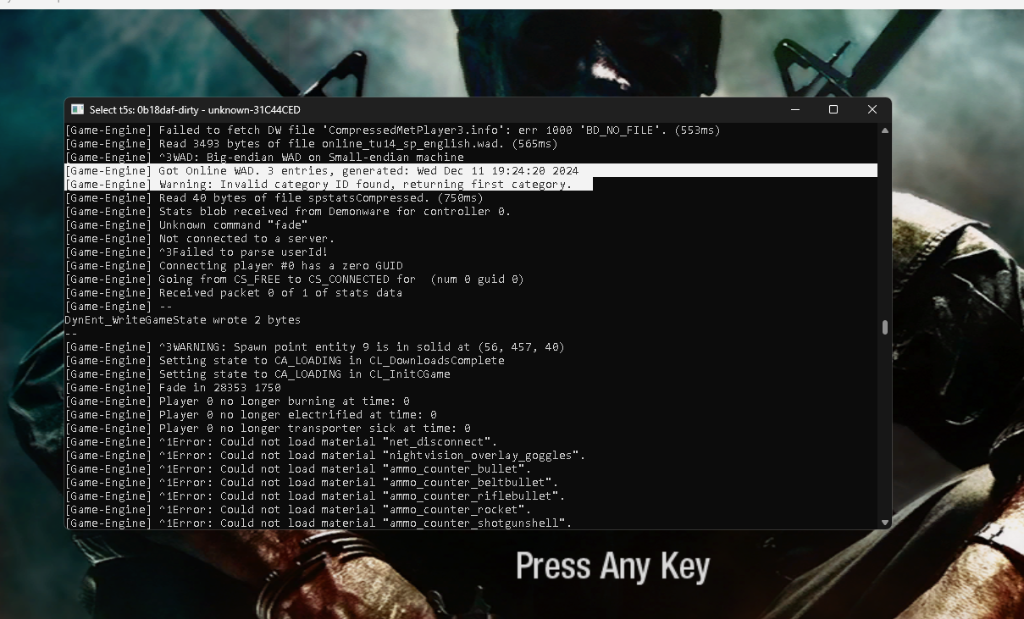
[Game-Engine] Failed to fetch DW file 'CompressedMetPlayer3.info': err 1000 'BD_NO_FILE'. (553ms)
[Game-Engine] Read 3493 bytes of file online_tu14_sp_english.wad. (565ms)
[Game-Engine] ^3WAD: Big-endian WAD on Small-endian machine
[Game-Engine] Got Online WAD. 3 entries, generated: Wed Dec 11 19:24:20 2024
[Game-Engine] Warning: Invalid category ID found, returning first category.
[Game-Engine] Read 40 bytes of file spstatsCompressed. (750ms)
[Game-Engine] Stats blob received from Demonware for controller 0.
Notice the three groundbreaking confirmations in this log:
- The Live Download (
565ms): The client fetchesonline_tu14_sp_english.wad(3,493 bytes) directly from the official Activision/Demonware storage servers upon initialization. - The Endianness Warning:
^3WAD: Big-endian WAD on Small-endian machine! The engine's low-level filesystem parser explicitly verifies that the WAD was compiled in Big-Endian format (PowerPC Xbox 360 / Cell BE) and executes runtime byte-swapping routines (_byteswap_ulong) to unpack it on modern x86/x64 Small-Endian CPU architecture. - Server Generation Timestamp:
Got Online WAD. 3 entries, generated: Wed Dec 11 19:24:20 2024. Demonstrating that Demonware's server pipeline generated and signed this exact bundle for Microsoft Store distribution.
4. What is Actually Inside Those Demonware .wad Files?
By writing a parser for T3WadHeader and inflating each zlib stream at filePos, we can extract every single lump from the .wad files in /storage/demonware/:
online_tu14_mp_english.wad (Black Ops 1 / T5 — Built Oct 1, 2015 / May 1, 2012)
| Lump # | Lump Name | Compressed | Decompressed | Purpose in Engine |
|---|---|---|---|---|
0 |
contracts.dat |
16,652 B | 160,573 B | Full table of Multiplayer Mercenary Contracts, COD Points rewards, and timers. |
1 |
geogroups.info |
357 B | 545 B | Matchmaking geographic routing table (#Los Angeles, US LAX 1, #New Jersey, US EWR 1, etc.). |
2 |
motd-mp-english.txt |
131 B | 165 B | Message of the Day ticker text at the bottom of the Multiplayer screen. |
3 |
playlists_mp.info |
7,157 B | 76,350 B | All MP & Wager Match playlists, map rotations, rulesets, and live setdvar overrides. |
4 |
restrict_access_wad_mp.csv |
100 B | 135 B | Remote DVAR ACL table (dvarname,client,unranked,ranked action) to remotely lock/unlock console DVARs. |
Historical Easter Egg Inside the WADs:
Comparing the official 2012 Demonware dump (18409) against the modded T5M/Plutonium dump (18301) reveals a piece of Call of Duty history frozen in time:
- In the untouched May 1, 2012 WAD (
18409),motd-mp-english.txtreads:"Black Ops 2 officially revealed! Head to www.facebook.com/codblackops to watch the reveal trailer. Follow @pcdev on twitter..."- In the 2015 custom client WAD (
18301), the old T5M developers repacked the WAD somotd-mp-english.txtreads"T5M got ^5REKT"andmotd-sp-english.txtreads"^5Demynnfire ^7loves you ^1<3^6<3 This just in: Leaderboards! Zombies are fun!"
online_tu17_mp.wad & online_tu17_zm.wad (Black Ops 2 / T6 — Title Update 17)
| Lump # | Lump Name | Compressed | Decompressed | Purpose in Engine |
|---|---|---|---|---|
0 |
playlists_mp.info |
46,495 B | 223,534 B | Complete BO2 Multiplayer playlists (Version 1736), map weights, and live setdvar hotfixes. |
1 |
codtv-mp.json |
1,496 B | 9,618 B | Folder & feed hierarchy for BO2's COD TV / Theater Mode community shares. |
2 |
voting-mp.json |
362 B | 1,327 B | In-game community voting poll definitions and expiration timestamps. |
3 |
motd-mp-english.json |
496 B | 808 B | Structured JSON Message of the Day popup banner. |
4 |
leagues.info |
6,481 B | 40,232 B | League Play competitive divisions, ranks, skill subdivision icons, and rulesets. |
5 |
message_encryption.dat |
183 B | 1,280 B | Key material blob for Demonware client-server telemetry encryption. |
6 |
entitlements.info |
308 B | 941 B | Bitmask key definitions for Season Pass & DLC ownership checks. |
7 |
youtube.info |
219 B | 262 B | Hardcoded Google YouTube Data API v2 developer key used by BO2's built-in Livestreaming feature! |
(And online_tu17_zm.wad carries the 4 equivalent lumps for Zombies: codtv-zm.json, voting-zm.json, motd-zm-english.json, and playlists_zm.info).
4. Write Your Own Demonware .wad Unpacker (Node.js)
Want to unpack and inspect these .wad files yourself? Here is a complete, zero-dependency Node.js script that parses the 0x543377AB header and inflates every lump:
const fs = require('fs');
const zlib = require('zlib');

function unpackTreyarchWad(wadPath) {
    const buf = fs.readFileSync(wadPath);
    const magic = buf.readUInt32LE(0);
    if (magic !== 0x543377AB) {
        throw new Error(`Invalid T3WAD magic: 0x${magic.toString(16)}`);
    }

    const timestamp = new Date(buf.readUInt32LE(4) * 1000).toISOString();
    const lumpCount = buf.readUInt32LE(8);
    const version = buf.readUInt32LE(12);

    console.log(`[T3WAD] ${wadPath} | Built: ${timestamp} | Lumps: ${lumpCount} | Ver: ${version}`);

    let dirOffset = 16;
    for (let i = 0; i < lumpCount; i++) {
        const rawName = buf.subarray(dirOffset, dirOffset + 32);
        const nullIdx = rawName.indexOf(0);
        const name = rawName.subarray(0, nullIdx >= 0 ? nullIdx : 32).toString('utf8');

        // Directory integers are Big-Endian (Network / Console byte order)
        const compSize = buf.readUInt32BE(dirOffset + 32);
        const decompSize = buf.readUInt32BE(dirOffset + 36);
        const filePos = buf.readUInt32BE(dirOffset + 40);

        const compressedSlice = buf.subarray(filePos, filePos + compSize);
        const decompressed = zlib.inflateSync(compressedSlice);

        console.log(`  -> [${i}] ${name} (${compSize}B -> ${decompressed.length}B @ 0x${filePos.toString(16)})`);
        dirOffset += 44;
    }
}
5. Do Modern Call of Duty Games (BO3, MW19, Cold War, BO6) Still Use .wad?
Starting with Black Ops 3 (T7) and Black Ops 4 (T8), and continuing into the unified IW8 / IW9 engines (Modern Warfare 2019, Black Ops Cold War, MWII, MWIII, Black Ops 6):
- Live Hotfixes Moved to
FFOTD&.lpf: Because T7+ introduced the Lua UI (LUI) virtual machine and hot-patchable GSC/CSC ScriptBundles, simple text playlists were no longer enough for live updates. Demonware Publisher Storage shifted to servingcore_ffotd_tuXX_*.ff(FastFile of the Day) and signed playlist/hotfix archives. - Heavy Assets Moved to
.xpak& CAS.pak: Streamed textures, audio, and geometry moved to LZ4/Oodle-compressed.xpak(T7/T8/T9) and Content-Addressable Storage (CAS).pakcontainers (IW8/IW9). - Legacy Naming Survives in Engine Symbols: Even when the file extension changed, internal C++ symbols and DVAR tables inside the Demonware
bdTitleUtilitieswrapper still reference "online WAD" loading tasks (LiveStorage_GetOnlineWad,restrict_access_wad) as a fossilized holdover from the T5/T6 era!
Part 4: How id Tech 7 & id Tech 8 Handle WADs Today
What about id Software itself — the birthplace of the WAD? How do modern id Tech 7 (DOOM Eternal) and id Tech 8 (DOOM: The Dark Ages) treat .wad files?
There are two sides to the story: literal legacy .wad support and the modern .resources / .streamdb architecture.
1. Literal .wad Execution Inside id Tech 7 (base/classicwads/)
If you browse the installation directory of DOOM Eternal (id Tech 7), you will find a folder that looks straight out of 1994:
DOOM Eternal/
 └── base/
      └── classicwads/
           ├── doom.wad    (The Ultimate DOOM IWAD)
           └── doom2.wad   (DOOM II: Hell on Earth IWAD)
Why are unmodified 1993/1994 .wad files sitting inside a cutting-edge Vulkan engine?
Inside the Fortress of Doom (the Doom Slayer's orbital hub — located in the Mars/Earth system!), there is an old 1990s CRT computer on the Slayer's desk. When you interact with it, id Tech 7 boots a native, embedded classic DOOM engine instance that renders directly into a virtual CRT texture inside the 3D scene and reads base/classicwads/doom.wad and doom2.wad using the classic wadinfo_t / filelump_t lump loader!
In fact, PC modders quickly discovered that because id Tech 7's embedded emulator uses standard W_Init lump parsing, you can replace or drop custom vanilla-compatible .wad files into base/classicwads/ and play custom DOOM levels on the Doom Slayer's computer inside DOOM Eternal.
2. From .wad to .resources & .streamdb (The 64-Bit Spiritual Successor)
For its own native assets, id Tech 7 and id Tech 8 no longer use .wad or .pk4. Instead, they split the archive system into two specialized container types:
.resourcesArchives (Logic, Decls, Base Metadata & Meshes):- Conceptually, an id Tech 7
.resourcesfile (IDCLheader) is the 64-bit, Oodle-Kraken-compressed descendant of Carmack's 1993 WAD. - Just like a WAD has a header pointing to a flat Lump Directory (
infotableofs), a.resourcescontainer has a binary header pointing to a 64-bit Resource Directory Table (filepos,compressedSize,uncompressedSize,resourceType,nameHash, and dependency indices). - Even classic DOOM's PWAD override philosophy lives on: id Tech 7 modding tools (
EternalModInjector/SAMUEL) inject modded assets by patching the.resourcesoffset directory and updating container hashes, echoing how PWADs shadowed IWAD lumps 30 years ago.
- Conceptually, an id Tech 7
.streamdbArchives (GPU-Direct MegaTexture / Geometry Streaming):- Classic WADs loaded entire lumps into CPU RAM. In a modern 4K engine, decompressing gigabytes of textures and high-poly meshes on the CPU would cause severe frame-time spikes.
.streamdbfiles store pre-tiled texture mipmaps and geometry LOD pages indexed by 64-bit hash keys. At runtime, id Tech 7/8 streams compressed blocks directly from NVMe storage into Vulkan device-local VRAM (and via DirectStorage GPU decompression in id Tech 8), bypassing traditional filesystem overhead entirely.
Conclusion
From a 12-byte header and 8-character lump names in 1993 DOOM, to Treyarch's undocumented 0x543377AB (T3w\xAB) Demonware .wad containers powering Call of Duty: Black Ops live-service playlists, to base/classicwads/ and 64-bit .resources tables in DOOM Eternal — the WAD is one of the longest-living architectural patterns in video game history.
Want to see classic
.wadloading in action right now?
Open the CLI Terminal on this portfolio and typemars(ordelicia doom) to boot UZDoom (WebAssembly) directly in your browser, complete with on-demand.wadstreaming and local IndexedDB caching!